

Why Tailoring Your Resume to Each Job Is Key to Getting Interviews
Landing a job today is harder than ever, not because people lack skills, but because most resumes never reach a real person. With companies using Applicant Tracking Systems and receiving hundreds of applications for a single role, your resume can disappear before a recruiter even sees your name. That’s why resume tailoring has become the deciding factor between getting noticed and getting ignored.
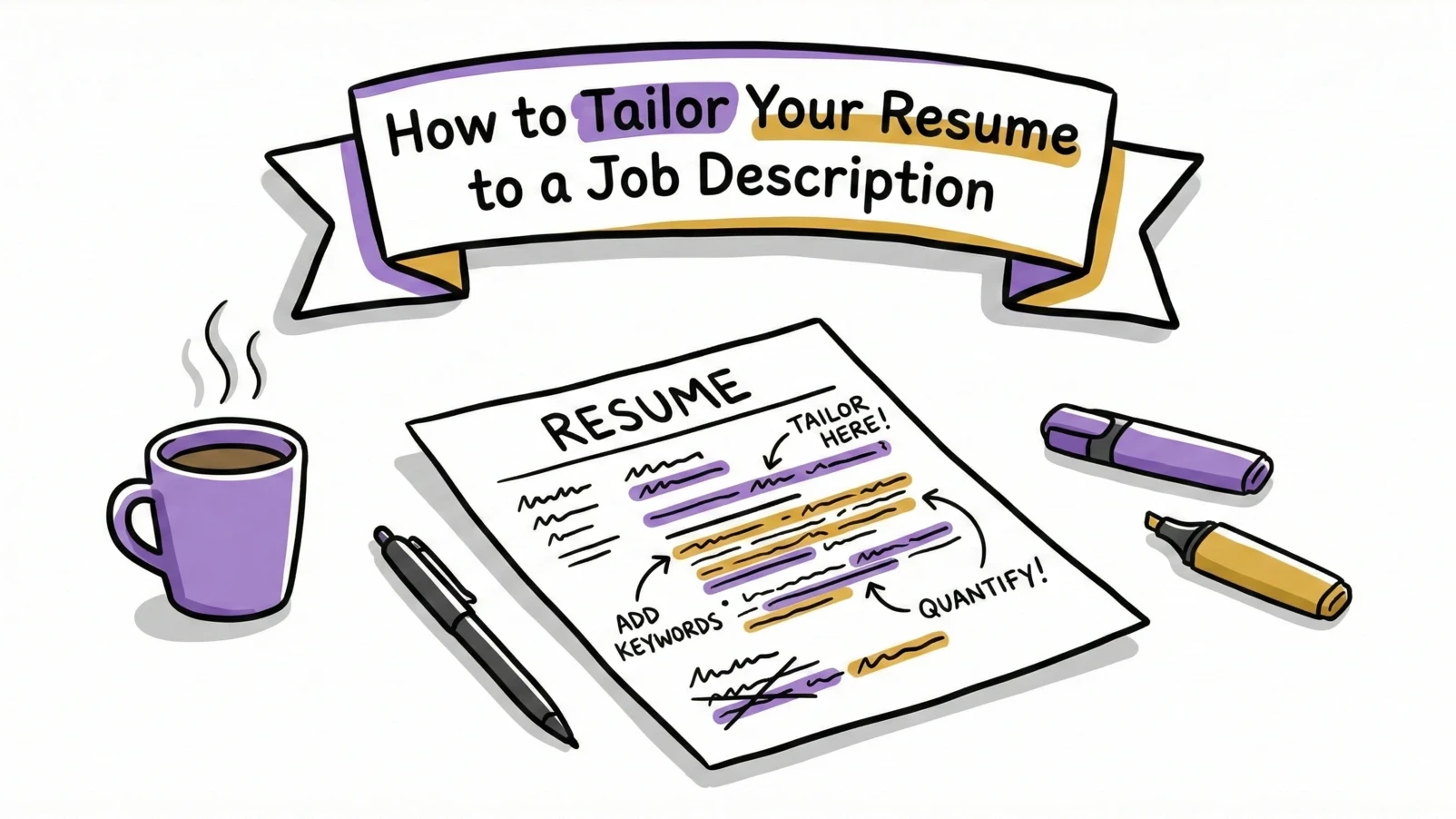
Instead of sending the same generic resume everywhere, the candidates who win interviews are the ones who align their experience with the language and priorities in each job description. It’s not about reinventing your career story. It’s about presenting it in a way that clearly matches what the employer is looking for.
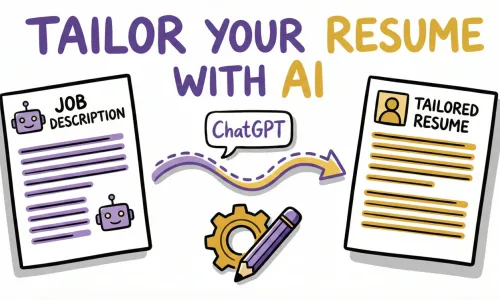
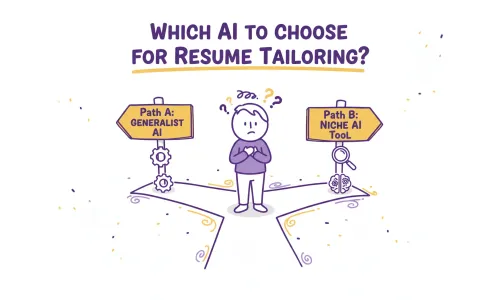
The problem is that tailoring a resume manually takes time - often an hour or more for a single application. New AI tools are changing that. Platforms like Reztune let you tailor your resume to a job description instantly, making it easier to stand out, pass ATS filters, and show employers why you’re the right fit.
The Mechanics of Selection: Applicant Tracking Systems (ATS) and AI Resume Filters
To master the art of being a successful resume tailor, one must first possess a deep, technical understanding of the filtration systems that govern the hiring funnel. The selection process is a bifurcated system involving two distinct gatekeepers: the algorithmic filter (ATS) and the cognitive filter (the human recruiter). To tailor resume content effectively is not merely "polishing" a document; it is an engineering task designed to satisfy the rigorous constraints of both gatekeepers simultaneously.
The Algorithmic Gatekeeper: The Applicant Tracking System (ATS)
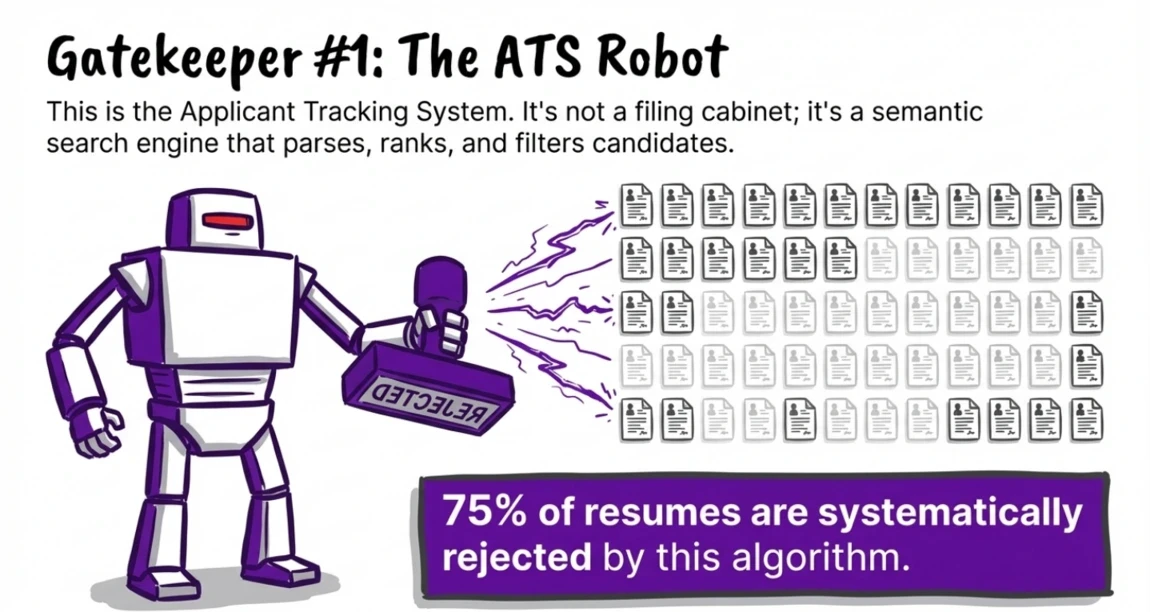
The Applicant Tracking System is often misunderstood by job seekers as a simple file storage system. In reality, it is a sophisticated semantic search engine and database management system designed to parse, rank, and filter human capital data at scale. Understanding its architecture is the first step to optimize your resume.
The Parsing Architecture and Data Extraction
When a candidate uploads a resume, the ATS does not "read" the document in the human sense. It initiates a parsing sequence. This process involves stripping the document of its visual styling - fonts, colors, columns, and graphics - to extract raw text data. This raw data is then mapped to specific fields in the recruiter’s database, such as "Education," "Current Title," "Years of Experience," and "Technical Skills."
The implications for how you customize your resume are profound. If a resume is heavily formatted with text boxes, tables, or non-standard headers, the parser may fail to identify the data correctly. For instance, if a candidate lists their skills in a side column within a text box, an older ATS parser might skip that content entirely, resulting in a "0% match" for critical skills even if the candidate possesses them. Therefore, the foundation of resume optimization is not just content, but structural compliance - using a clean, linear hierarchy that the algorithm can ingest without error.
Semantic Matching and Keyword Weighting
Once parsed, the resume is subjected to a matching algorithm. Early iterations of ATS software relied on simple "Boolean" keyword counting - checking if the exact string "Project Manager" appeared in the text. Modern systems, however, utilize AI and Natural Language Processing (NLP) to perform contextual analysis.
Despite these advancements, the "Exact Match" heuristic remains a dominant factor in ranking. Algorithms assign a relevance score or "match rate" to every resume based on the density and placement of specific keywords extracted from the job description.
- High-Value Zones: Keywords appearing in the "Resume Summary," "Headline," or "Job Titles" are weighted more heavily than those found in the lower "Interests" section.
- The Synonym Problem: While advanced AI can understand that "Client Relations" and "Customer Service" are related, many legacy systems still punish candidates for using synonyms. If the job description demands "SaaS Sales" and the resume lists "Software Sales," the candidate may be penalized in the ranking. This necessitates a strategy of precise "mirroring," where the candidate adopts the exact nomenclature of the employer.
The Cognitive Gatekeeper: Recruiter Psychology and the "7-Second Scan"
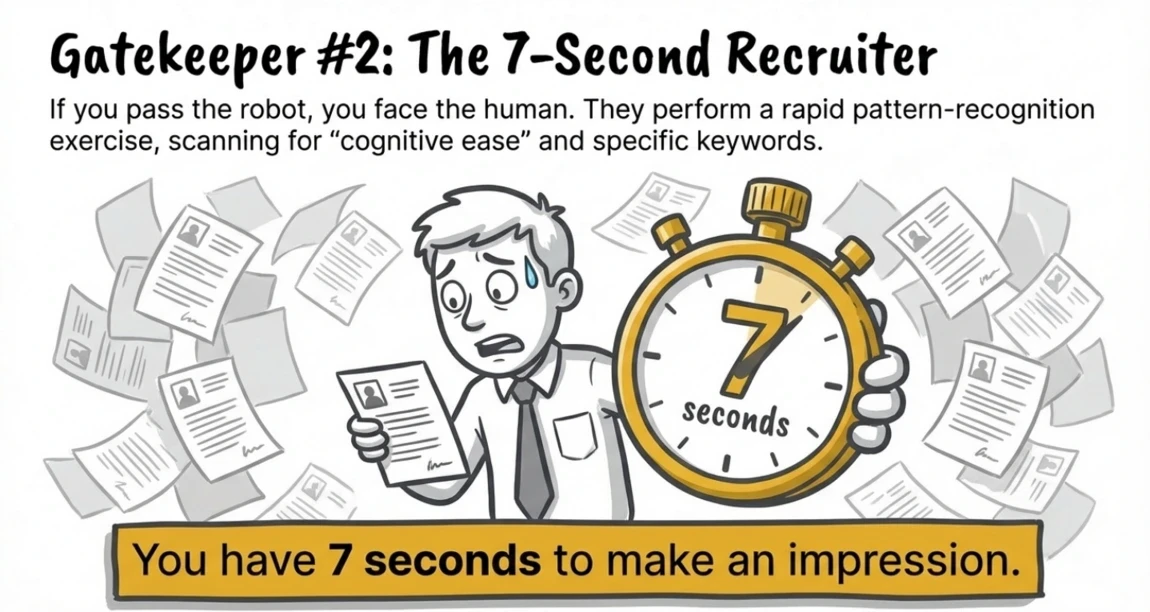
If a targeted resume successfully navigates the ATS, it faces the human constraint. Research consistently indicates that recruiters spend an average of only 7 seconds on their initial review of a resume. This is not a deep reading; it is a rapid pattern-recognition exercise.
Cognitive Ease and Pattern Recognition
In this brief window, the recruiter is not evaluating the candidate's entire career history. They are scanning for "cognitive ease" - specific visual and textual cues that confirm the candidate fits the mental model of the role.
- Title Matching: The first thing a recruiter looks for is a current job title that matches the vacancy. If the company is hiring a "Senior Data Analyst" and the resume leads with "Math Teacher," the cognitive load increases. The recruiter has to mentally translate the skills, which creates friction and leads to rejection.
- Visual Anchors: Recruiters scan for bolded keywords (skills, tools, software) that align with their "must-have" list. A tailored resume places these anchors strategically to arrest the recruiter's eye.
The Risk of the Generic Resume
A generic, "one-size-fits-all" resume signals a lack of investment. To a recruiter, a resume that lists irrelevant skills or generic duties implies that the candidate is "spraying and praying" - applying to hundreds of jobs without reading the descriptions. To tailor your resume, conversely, acts as a costly signal of intent. It demonstrates that the candidate has internalized the company’s specific needs and has taken the time to curate their presentation accordingly. This psychological signal is often as valuable as the skills themselves.
Phase I: Identify Job Description Requirements
The process to resume tailor begins not with writing, but with forensic reading. A job description is a coded document; it contains explicit requirements, implicit cultural values, and prioritized needs. The candidate must analyze the JD to extract the DNA of the ideal candidate.
Distinguishing "Must-Haves" from "Nice-to-Haves"
Job descriptions are often a wish list, a composite of the hiring manager's ideal (and sometimes unrealistic) expectations. The first task is to triage these requirements.
- Frequency Analysis: The most reliable indicator of importance is repetition. If the phrase "Cross-functional collaboration" appears in the summary, the responsibilities, and the qualifications sections, it is a non-negotiable core competency.
- Order of Operations: In the "Requirements" or "Qualifications" list, items listed in the top third are generally "deal-breakers," while items at the bottom are often "nice-to-haves" or preferred qualifications. A resume for each job must address the top-third requirements prominently in the Resume Summary or the most recent job entry.
Decoding the "Invisible" Requirements
Beyond the bulleted lists, the narrative sections of the JD reveal the "invisible" requirements - the tone, culture, and soft skills that determine fit.
- Cultural Coding: A JD that uses words like "Ninja," "Rockstar," "Fast-paced," and "Scrappy" is signaling a specific startup culture that values speed, autonomy, and potentially long hours. A resume tailored for this role should use energetic action verbs ("Accelerated," "Launched," "Built").
- Corporate Coding: Conversely, a JD that emphasizes "Governance," "Compliance," "Stakeholder Management," and "Process" signals a mature, perhaps bureaucratic environment. A resume for this role should emphasize stability, precision, and consensus-building ("Orchestrated," "Standardized," "Optimized").
The T-Chart Analysis Method
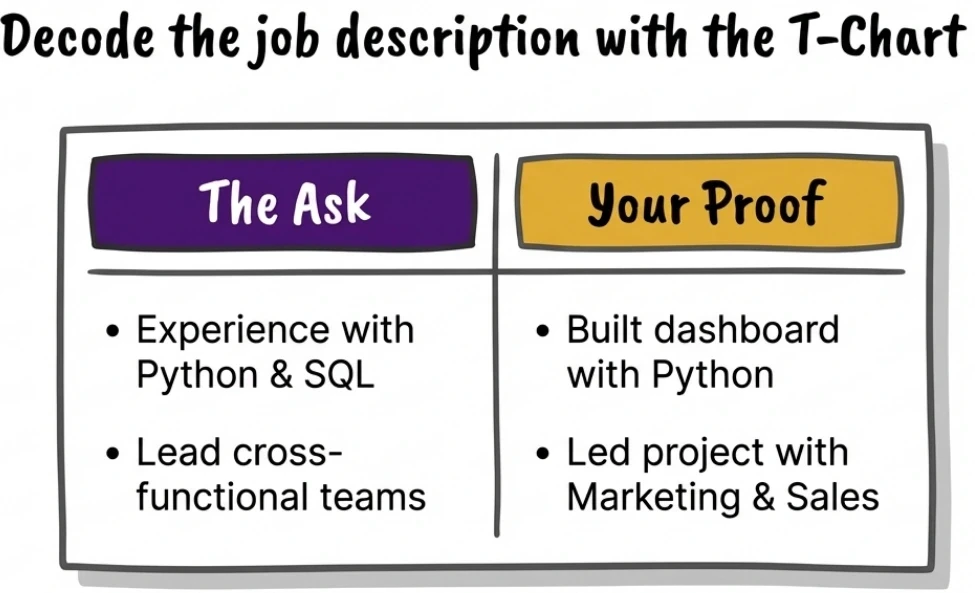
To systemize this analysis, domain experts recommend the T-Chart Method. This is a manual worksheet used to map the candidate's inventory against the employer's demand.
| Employer Needs (The Ask) | Candidate Evidence (The Proof) | Action |
|---|---|---|
| Requirement: "Experience with Python and SQL for data visualization." | Evidence: "Built an automated dashboard using Python scripts and SQL queries to track Q3 sales." | Strategy: Add "Python" and "SQL" to Skills section; rewrite bullet point to highlight dashboard creation. |
| Requirement: "Ability to lead cross-functional teams." | Evidence: "Led a project involving Marketing, Sales, and Product departments." | Strategy: Use the exact phrase "Cross-functional leadership" in the Resume Summary. |
| Requirement: "MBA Preferred." | Evidence: "Currently enrolled in MBA program." | Strategy: List "MBA (Candidate)" in Education section to capture the keyword. |
This gap analysis reveals exactly what needs to be emphasized and what is missing. It prevents the common mistake of emphasizing skills the candidate is proud of but the employer doesn't care about.
Phase II: Extracting Keywords to Optimize Your Resume
Once the requirements are identified, they must be converted into a specific taxonomy of keywords that will drive the ATS match score. Keywords generally fall into three categories: Hard Skills, Soft Skills, and Academic/Functional markers.
Hard Skills (The Anchors)
Hard skills are quantifiable, teachable abilities that are easily measured. These are the primary filters for the ATS.
- Examples: Software (Salesforce, Jira), Languages (Spanish, Python), Certifications (PMP, CPA), Methodologies (Agile, Six Sigma), Technical Processes (Financial Modeling, SEO).
- Extraction Strategy: Scan the "Skills" and "Qualifications" sections of the job description. Note the exact spelling and terminology. If the JD says "React.js" and the resume says "ReactJS," use the JD's version to ensure an exact match.
Soft Skills (The Differentiators)
Soft skills act as the "closers" for the human reader. They describe how a candidate works.
- Examples: Communication, Problem-Solving, Adaptability, Time Management, Leadership.
- Integration Strategy: Soft skills should rarely be listed in a "Skills" list (where they look like fluff). Instead, they should be woven into the work experience bullets. Instead of listing "Leadership," write: "Led a team of 10...".
The "Keyword Stuffing" Trap
A critical error in manual tailoring is "keyword stuffing" - the practice of jamming every possible keyword into the resume, sometimes as white text on a white background or in nonsensical lists. Modern ATS algorithms are designed to detect and penalize this behavior. The goal is Contextual Integration: keywords must appear naturally within the narrative of the resume.
Phase III: Mapping Keywords to Your Resume Template
Mapping is the strategic placement of extracted keywords into the resume's architecture. The placement of a keyword dictates its weight in the scoring algorithm.
The Heat Map of Resume Real Estate
Not all sections of a resume are created equal.
- The Headline/Title: This is the highest-value real estate. If the target job is "Project Manager" and the candidate's past title was "Project Coordinator," the candidate can use a functional headline like "Project Management Professional" or "Project Coordinator (Acting Project Manager)" to ensure the primary keyword is indexed immediately.
- The Resume Summary: This section acts as the SEO meta-description of the resume. It should contain the top 3-4 distinct keywords found in the job description.
- The Skills Section: This is a dedicated block for hard skills, allowing for a high density of keywords in a readable format. Grouping them (e.g., "Design Tools: Photoshop, Illustrator, Figma") helps the human reader parse the data quickly.
Handling Mismatched Resume Titles
A common challenge arises when a candidate's internal job title differs from the market standard. For example, a candidate might be titled "Member Success Specialist" internally, but the market equivalent is "Customer Support Manager."
- Tailoring Tactic: The candidate should list the internal title for background check accuracy, but follow it with the market-standard keyword in parentheses.
- Example: Member Success Specialist (Customer Support Manager)
- This satisfies the background check (Title 1) and the ATS/Recruiter (Title 2) simultaneously.
Phase IV: Rewriting Bullets to Tailor Resume to the Job Posting
The "Work Experience" section is the engine of the resume. To tailor resume content here requires a fundamental shift in writing style: moving from Duty-Based writing to Achievement-Based writing.
The Shift from Duties to Accomplishments
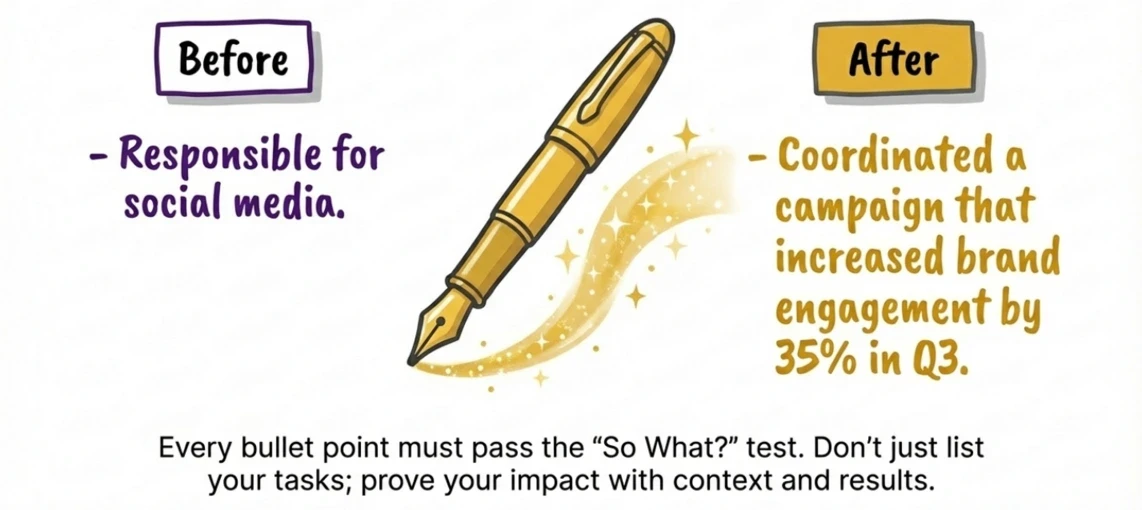
Most generic resumes list duties: "Responsible for managing sales team." This tells the recruiter nothing about the candidate's effectiveness - only what they were supposed to do. Resume tailoring transforms this into an accomplishment that addresses a specific pain point in the job description.
- Generic Duty: "Wrote blog posts."
- Tailored Achievement: "Authored 25+ SEO-optimized blog posts that increased organic web traffic by 40% year-over-year, directly supporting the company's inbound marketing strategy."
The Problem with "Blind Quantification"
A prevailing myth in resume writing is that any number is a good number. This leads to "Blind Quantification" or the use of Vanity Metrics. These are numbers that look impressive but lack context, business relevance, or causation.
Vanity Metrics vs. Meaningful Achievements
- Vanity Metric (Blind): "Sent 5,000 cold emails per month."
- Critique: This is a measure of activity (busyness), not impact. A spam bot can send 5,000 emails. Did anyone open them? Did they generate revenue? It creates a "So what?" reaction in the recruiter.
- Meaningful Achievement (Contextual): "Executed a high-volume email outreach campaign (5k/month) that achieved a 4% conversion rate - 2x the industry average - generating $150k in pipeline revenue in Q3."
- Analysis: This bullet provides the Volume (5k), the Context (2x industry avg), and the Business Result ($150k revenue). It proves competence, not just effort.
The "So What?" Test
Every bullet point must pass the "So What?" test. If a candidate writes "Managed a budget of $500,000," the recruiter asks "So what? Did you lose it? Did you spend it all?"
- Better: "Managed a $500,000 operating budget, identifying 15% in cost savings through strategic vendor consolidation."
Comparison: Transforming Bullets for Impact
The following table illustrates the transformation of generic bullets into tailored, meaningful narratives.
| Generic / Duty-Based Bullet | Critique | Tailored & Meaningful Bullet |
|---|---|---|
| "Responsible for customer service and answering phones." | Passive, duty-focused, no metric. | "Resolved 50+ customer inquiries daily with a 98% satisfaction rating, reducing escalation rates by 20% through effective conflict resolution." |
| "Worked on the marketing team to help with social media." | Vague, low ownership. | "Coordinated a cross-channel social media campaign that increased brand engagement by 35% in Q3, leveraging Instagram and LinkedIn analytics to optimize content." |
| "Used Python to analyze data." | Tool-focused, no outcome. | "Developed Python scripts to automate data entry processes, saving 15 hours of manual labor per week and eliminating data entry errors." |
| "Led a team of 5 people." | Descriptive, lacks leadership impact. | "Mentored and directed a 5-person sales team, improving collective quota attainment from 80% to 110% within 12 months through targeted coaching." |
Phase V: Validating Tone to Increase Your Chances of Getting the Role
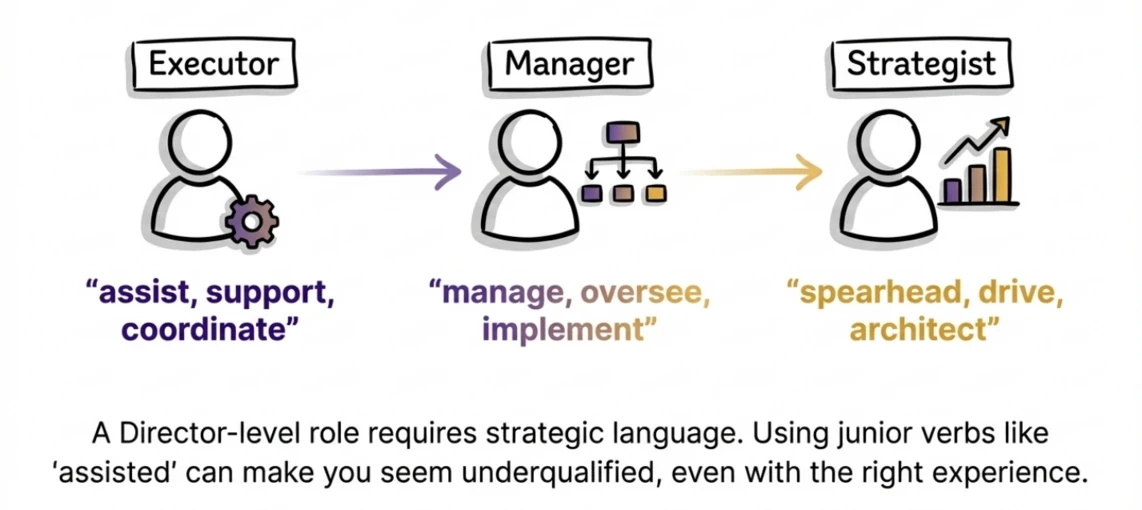
A resume must do more than list skills; it must speak the language of the target seniority level. The tone of the resume tells the recruiter whether the candidate is an "Executor" (Junior), a "Manager" (Mid-Level), or a "Strategist" (Senior/Executive).
Identifying the Tone and Level of Responsibility
The job description provides the clues for the required register.
- Operational Language (Junior/Associate): Words like assist, support, coordinate, monitor, participate, draft. These imply the candidate helps others achieve goals.
- Tactical Language (Mid-Level): Words like manage, oversee, implement, analyze, supervise, train. These imply the candidate owns a process or a team.
- Strategic Language (Senior/Executive): Words like spearhead, drive, conceptualize, architect, transform, optimize, ROI, P&L. These imply the candidate owns the business outcome and sets the direction.
Aligning the Resume Voice
If a candidate is applying for a Director-level role but uses operational verbs like "Helped" or "Assisted," they will be perceived as underqualified, even if their experience is relevant. The resume tailor process involves upgrading the verbs.
- Before (Too Junior): "Helped the VP with the annual budget planning."
- After (Senior): "Collaborated with the VP to architect the annual fiscal budget, aligning resource allocation with strategic growth initiatives."
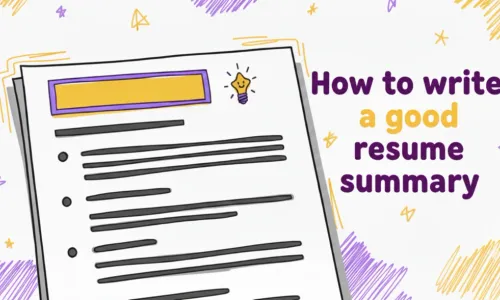
Phase VI: Writing a Good Resume Summary with Resume Examples
The Resume Summary is the narrative hook of the resume. Located at the very top, it is the first thing read and the most heavily weighted section for SEO. It must be rewritten for every single application to serve as a specific thesis statement for this specific job.
The Summary Formula
A generic summary ("Hardworking professional looking for a challenge...") is a wasted opportunity. A tailored summary follows a strict formula:
- Identity & Years.
- The "Hook": A major achievement or skill set that directly answers the JD's biggest need (The "Must-Have").
- The Value Proposition: A closing statement on the specific value the candidate brings to this company.
Tailoring by Seniority
- Entry-Level Summary: Focus on potential, education, and adaptability.
- Example: "Honors Graduate with a BS in Marketing and internship experience in social media management. Passionate about leveraging data analytics (Google Analytics, SQL) to drive brand growth and engagement..."
- Executive Summary: Focus on vision, track record, and financial impact.
- Example: "Chief Operations Officer with 15+ years of experience scaling SaaS startups from Series A to Exit. Proven track record of optimizing P&L, reducing burn rate by 20%, and leading global cross-functional teams of 200+..."
The Manual Burden: Why It's Hard to Tailor Your Resume for Every Job
The methodology outlined in the previous sections is effective, but it is also extraordinarily resource-intensive. To manually execute a forensic analysis of the JD, create a T-Chart, rewrite the summary, optimize bullet points, and reformat the document for ATS compliance takes an estimated 45 to 90 minutes per application.
The "Time Tax" and Application Fatigue
For a job seeker attempting to apply to 10 jobs per week, this manual process requires 7 to 15 hours of unpaid labor. This high friction creates "Application Fatigue," leading candidates to cut corners. They begin to skip the T-Chart, use generic summaries, or fail to customize bullets. As the quality of the application drops, the rejection rate rises, creating a negative feedback loop that can be demoralizing.
The Risk of Human Error
Even with diligent effort, manual tailoring is prone to error. Candidates may miss "invisible" keywords, misinterpret the seniority tone, or accidentally break the ATS formatting (e.g., by using columns or headers that the parser cannot read).
Automation: Using an AI Tool like Reztune to Instantly Tailor
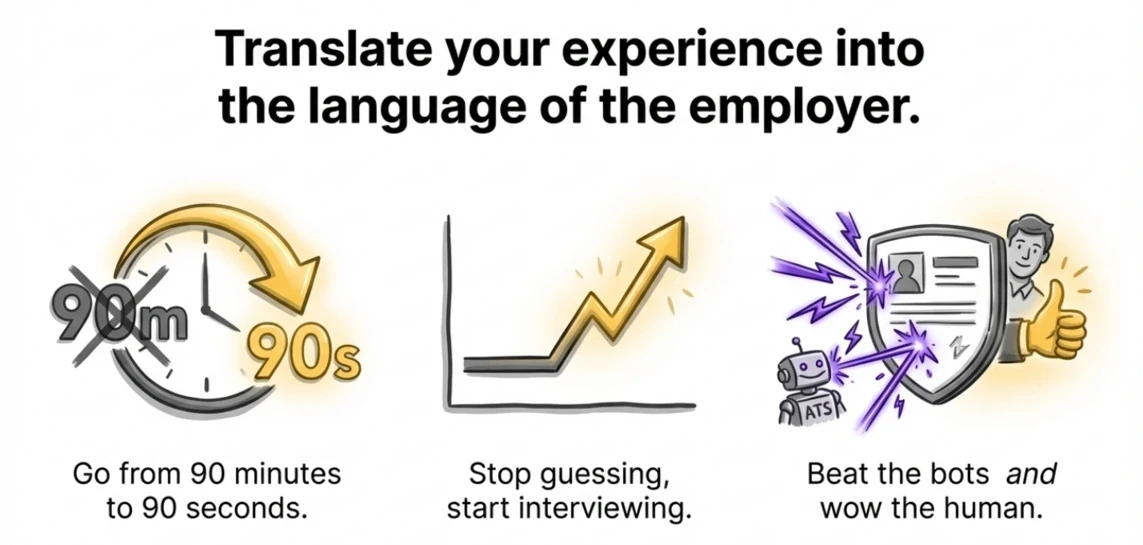
To address the inherent inefficiencies of manual tailoring, the market has shifted toward AI-driven automation. Reztune represents the vanguard of this shift, positioning itself not merely as a resume builder, but as an AI tool and Application Accelerator. It transforms the 90-minute manual ordeal into a single-click, 90-second operation, without sacrificing the depth or nuance required for success.
How Reztune Automates the Resume Tailoring Process
Reztune effectively automates every phase of the manual process described in this report, leveraging deep learning to use AI to write and perform forensic analysis simultaneously.
- Automated Identification (Phase I): Instead of a manual read-through, Reztune’s engine scans the target JD in seconds. It identifies the "Must-Haves," separates the hard skills from the soft skills, and detects the seniority tone.
- Instant Keyword Extraction & Mapping (Phase II & III): Reztune performs an instant gap analysis. It compares the user's master profile against the JD’s requirements, highlighting exactly which keywords are missing. It identifies "invisible" keywords (industry terms the user knows but forgot to list) and maps them to the appropriate sections.
- Contextual Rewriting (Phase IV): This is Reztune’s core differentiator. Unlike simple tools that just paste keywords, Reztune uses a 60-step AI pipeline to rewrite bullet points. It understands context. If the JD requires "Agile Methodology," Reztune doesn't just add the word "Agile"; it might rewrite a bullet to say "Managed product lifecycles using Agile methodologies to accelerate delivery..."
- Tone & Seniority Validation (Phase V): The AI analyzes the tone and level of responsibility of the JD. If the job is an Executive role, Reztune automatically upgrades verbs to be more strategic (e.g., changing "Ran" to "Directed"). If the role is technical, it prioritizes hard skills and specific toolsets.
- ATS-Optimized Templates (Final Output): Perhaps most critically, Reztune solves the parsing problem. It generates the final resume in a professional, ATS-verified resume template. These templates are engineered to be 100% parseable by major systems like Taleo, Greenhouse, and Lever, ensuring that the carefully tailored content is actually read by the machine.
The "All-in-One" Advantage
By consolidating analysis, rewriting, formatting, and optimization into a single tool, Reztune allows candidates to break the "Quality vs. Quantity" trade-off.
- Speed: Reduces application time from 60 minutes to <5 minutes.
- Precision: Eliminates human error in keyword identification.
- Outcome: Data suggests tailored resumes can get more interviews, with callbacks increasing by up to 40%.
Reztune does not replace the candidate's experience; it translates that experience into the precise dialect of the employer, ensuring that the candidate’s value is recognized by both the algorithm and the human.
Conclusion: The Future of the Job Application and AI Resume Tailoring
The era of the generic resume is effectively over. In a hyper-competitive, algorithmically mediated labor market, specificity is the currency of success. The candidate who relies on a static document is invisible; the candidate who tailors their resume to mirror the needs of the employer is the one who secures the interview.
The procedural framework outlined in this report - Identify, Extract, Map, Rewrite, Validate - provides a robust methodology for navigating this complex landscape. By distinguishing between vanity metrics and meaningful achievements, and by aligning tone with seniority, candidates can dramatically improve their standing. However, as the complexity of these requirements grows, the role of automation becomes increasingly central. Tools like Reztune offer a necessary bridge, democratizing access to professional-grade resume tailoring and allowing candidates to focus on what matters most: preparing for the interview.
Bonus: Comprehensive Resume Tailoring Checklist
- Forensic Analysis
- Scan JD for repeated keywords (Frequency = Priority).
- Identify top 3 "Must-Have" hard skills.
- Determine Seniority Tone (Operational vs. Strategic).
- Strategic Mapping
- Align Resume Headline with Job Title (use parentheses if needed).
- Ensure top keywords appear in the Resume Summary.
- Move relevant "Skills" to the top of the list.
- Content Optimization
- Rewrite Bullets: Convert duties to "Action + Context + Result."
- Metric Check: Replace Vanity Metrics (e.g., "Sent emails") with Meaningful Metrics (e.g., "Generated revenue").
- Voice Check: Upgrade verbs to match the seniority level of the JD.
- Technical Validation
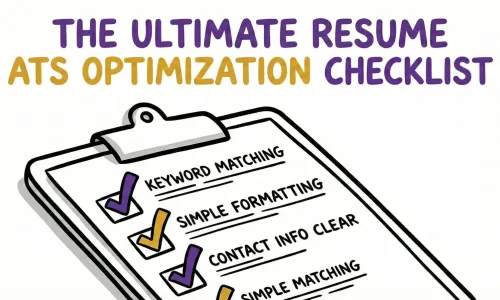
- ATS Compliance: Use a clean, single-column format (or Reztune resume template).
- Proofread: Zero tolerance for typos.
- File Type: Save as .docx or PDF (depending on ATS instruction).
Frequently Asked Questions (FAQ) about Resume Tailoring
Is it really necessary to tailor my resume for every job?
Yes. In today's competitive job market, sending a generic resume is rarely effective. To increase your chances of getting hired, you must create a resume for each job. A targeted resume that aligns with the job posting proves to the hiring manager that you have read the requirements and possess the specific skills from the job.
How can I tailor my resume in minutes?
Manual customization is slow. To produce a resume in minutes, you should use AI tools designed for AI resume tailoring. Platforms like Reztune allow you to instantly tailor your profile, helping you rewrite bullet points and optimize your resume without spending hours on a single job application.
Will using AI to write my resume help me pass ATS?
Absolutely. An AI resume tool often includes a resume scanner that mimics ATS software. It ensures your resume keywords match the job description and that your formatting is ATS-friendly. This helps your application pass ATS filters that reject qualified candidates simply for lacking specific terms.
Do I need to change my resume template for each job?
Not necessarily the design, but the content must change. However, using a clean, professional resume template is crucial. Avoid complex graphics that confuse applicant tracking systems. A good resume builder will provide templates that are optimized for both human readers and AI analysis.