


A CV summary is a short introduction near the top of your CV that highlights the experience, skills, and achievements most relevant to the job you want. Also called a professional profile, it gives the employer a clear reason to keep reading.
You can write yours using the examples below, or use Reztune's AI CV tailoring to generate it from your CV and the job description. The free tier includes three tailoring credits per month. Each credit produces a full tailored CV, including a summary for that job, which you can view for free. Downloading the formatted PDF requires payment.
Our recommendation is to tailor your summary for every application. Those few lines should make your fit obvious to this employer. Start with what the posting asks for, then choose the strongest evidence from your background.
What does a good CV summary look like?
Here is an example for a customer support role that asks for billing support, Zendesk experience, and clear documentation:
Customer support specialist with four years of experience resolving subscription billing and account-access issues through Zendesk. Writes help-centre articles and documents recurring problems for the product team, with experience training new support colleagues.
The reader can identify the candidate's experience, tools, and relevant responsibilities immediately. Each claim should also be supported by the experience section further down the CV.
We recommend two or three concise sentences, usually around 40–70 words. Put the summary below your contact details and above your experience, using a clear heading such as Professional Profile. The length is a practical writing target: keep the detail that helps the employer understand your fit and remove sentences that repeat it.
The candidates, job requirements, and summaries in this guide are illustrative. They demonstrate how to use declared background facts; they are not customer results or captured Reztune outputs.
One person, two jobs: how the summary should change
The same job title can describe very different work. A company hiring a marketing specialist might need someone to run email campaigns. Another might need someone to produce customer stories and sales materials. A candidate with experience in both should bring different evidence to the front of each application.
Consider this background:
- Four years as a marketing specialist at a software company.
- Managed email campaigns and segmented contact lists in HubSpot.
- Increased newsletter click-through rate from 2.1% to 3.0% over six months through subject-line and content tests.
- Interviewed customers and wrote eight case studies.
- Worked with sales colleagues to turn those stories into presentation materials.
- Tracked campaign results in Google Analytics and reported them monthly.
All the information used in the following summaries comes from those facts.
The generic version
Motivated marketing professional with strong communication skills and a passion for delivering results. Experienced in a range of marketing activities and looking for an opportunity to grow.
This gives the employer little to evaluate. It leaves out the tools, work, and results that could explain why this person fits the opening.
Job A: email marketing specialist
What the posting prioritises: HubSpot, audience segmentation, email testing, and campaign reporting.
Marketing specialist with four years of experience, including managing segmented email campaigns in HubSpot. Improved newsletter click-through rate from 2.1% to 3.0% over six months through subject-line and content tests, and reports campaign performance using Google Analytics.
The summary leads with the work this employer needs. The metric earns its space because it shows a result from that work. Customer interviews and case studies still belong in the candidate's background, but they do not need to compete for space in this opening paragraph.
Job B: content marketing specialist
What the posting prioritises: customer interviews, case studies, and content that supports sales conversations.
Marketing specialist with four years of experience, including interviewing customers and writing eight software case studies. Works with sales colleagues to turn customer stories into presentation materials and uses Google Analytics to report campaign results.
The person has the same experience. This summary selects the part that makes the strongest case for the second job.
Notice that the second version does not force in the email metric just because it is a number. Relevant work can be more persuasive than an impressive result from a less relevant task. Neither version claims four years exclusively in email or content marketing: the source facts only establish four years in the broader role.
This is the decision behind a targeted CV summary: which true details make it easiest for this employer to understand what you can contribute?
How to generate a CV summary with Reztune
Reztune is an AI CV summary generator as part of its full CV-tailoring workflow. It uses your existing experience and the actual job description to generate a summary for that opportunity, alongside the rest of your tailored CV.
The job description matters because a title alone does not explain the employer's priorities. As the marketing examples show, even closely related jobs can call for different opening paragraphs.
1. Add your base CV
Upload your existing CV, or create one in the editor if you are starting from scratch. Include the tools you have used, the work you have done, and any results you can substantiate. If useful experience is missing, add it. A summary becomes more specific when there is more relevant evidence to work with.
2. Paste the job description
Use the posting for the job you are applying to. Reztune analyses the requirements and terminology, compares them with your background, and rewrites your summary, experience, and skills around the opportunity.
That saves the repeated work of deciding what matters, finding the matching experience, and writing another version for each employer. The summary and the rest of the CV are prepared around the same job.
3. Review the generated summary in context
Read the summary alongside the experience section. Check that the opening emphasises the employer's main needs and that the supporting details appear elsewhere in the document.
Reztune is designed to present your real experience without inventing qualifications. You remain the source of truth. Review titles, years of experience, tools, and results, and approve any suggested additions only when they describe work you have actually done.
You can also inspect the requirement analysis to see where the CV provides support and where gaps remain. A requirement that you do not meet should not become a claim in your summary.
4. View the result for free or download the formatted PDF
The free tier gives you three tailoring credits each month. One credit prepares a complete tailored CV with a summary for one job. You can generate and view summaries for up to three jobs per month without paying.
Downloading the professionally formatted PDF requires a paid plan. If you only need the summary, you can manually transcribe the visible text into your existing CV.
For your next application, use the next posting to generate the relevant version. Your base experience stays reusable, while the summary changes with the employer's priorities.
CV summary examples for different backgrounds
Use these examples to understand the choices behind the wording. Replace the facts with your own and adapt the emphasis to your posting. Copying a polished example without checking its claims can leave you presenting experience you do not have.
Experienced customer support professional
Target: A subscription business seeking billing support, Zendesk experience, documentation, and colleague training.
Source facts: Four years in customer support; resolved billing and account-access issues in Zendesk; wrote help-centre articles; documented recurring problems for the product team; trained new support colleagues.
Customer support specialist with four years of experience resolving subscription billing and account-access issues through Zendesk. Writes help-centre articles and documents recurring problems for the product team, with experience training new support colleagues.
Why it works: Specific responsibilities demonstrate communication and problem-solving. There is no need to substitute broad claims such as “excellent people skills” for work the employer can recognise.
Career changer: retail supervisor to operations coordinator
Target: An operations coordinator role involving scheduling, stock records, supplier communication, and resolving delivery issues.
Source facts: Five years in retail, including two as a supervisor; prepared weekly schedules for 12 employees; maintained stock records in Excel; contacted suppliers about delayed deliveries; coordinated shift handovers.
Retail supervisor with five years of retail experience, including two coordinating staff schedules, stock records, and shift handovers. Prepares weekly schedules for 12 employees, maintains inventory records in Excel, and works with suppliers to resolve delivery delays.
Why it works: The summary makes the operational overlap visible while preserving the candidate's actual background. It does not rename the candidate an experienced operations coordinator before they have held that role.
Recent graduate applying for a junior analyst role
Target: A junior analyst opening asking for SQL, Excel, dashboards, and clear explanations of findings.
Source facts: Economics degree; a university project analysing public transport data using SQL and Excel; created a Power BI dashboard; presented findings to the project group. No paid analyst experience.
Economics graduate with project experience analysing public transport data using SQL and Excel. Built a Power BI dashboard and presented findings to a university project group, combining data analysis with clear visual reporting.
Why it works: The project supplies relevant evidence, and its context is explicit. The summary does not imply the graduate delivered commercial results or worked as a professional analyst.
Technical specialist: backend software engineer
Target: A backend engineering role emphasising Java services, PostgreSQL, and production troubleshooting.
Source facts: Six years as a software engineer; developed Java APIs backed by PostgreSQL; investigated production incidents; reduced one reporting endpoint's response time from eight seconds to two through query changes.
Software engineer with six years of experience, including developing Java APIs backed by PostgreSQL and investigating production incidents. Reduced a reporting endpoint's response time from eight seconds to two through query optimisation.
Why it works: It names the technology and the work behind it. The result is specific to one endpoint, so the summary does not inflate it into a claim about the entire platform.
Manager applying for a warehouse leadership role
Target: A warehouse manager opening focused on team supervision, shift planning, and inventory accuracy.
Source facts: Seven years in warehouse operations, including three supervising 18 staff; planned shifts; introduced weekly cycle counts; reduced recorded inventory discrepancies from 45 to 18 per month over six months.
Warehouse supervisor with seven years in warehouse operations, including three leading an 18-person team. Plans shifts and introduced weekly cycle counts that reduced recorded inventory discrepancies from 45 to 18 per month over six months.
Why it works: It separates total experience from management experience and shows the scope of responsibility. The improvement supports this posting's inventory priority.
Administrative professional without quantified achievements
Target: An administrative assistant opening involving scheduling, supplier invoices, and document organisation.
Source facts: Three years supporting a property management office; coordinated contractor appointments; checked supplier invoices against work orders; maintained shared records and followed up on missing paperwork. No measured savings or efficiency results.
Administrative assistant with three years supporting a property management office. Coordinates contractor appointments, checks supplier invoices against work orders, and maintains shared records with follow-up on missing documentation.
Why it works: Responsibilities and context can establish relevance without a percentage. Do not manufacture a time-saving claim when you have not measured one.
How to write your own CV summary
The examples follow a repeatable process. You can use it to write from scratch or improve a summary you already have.
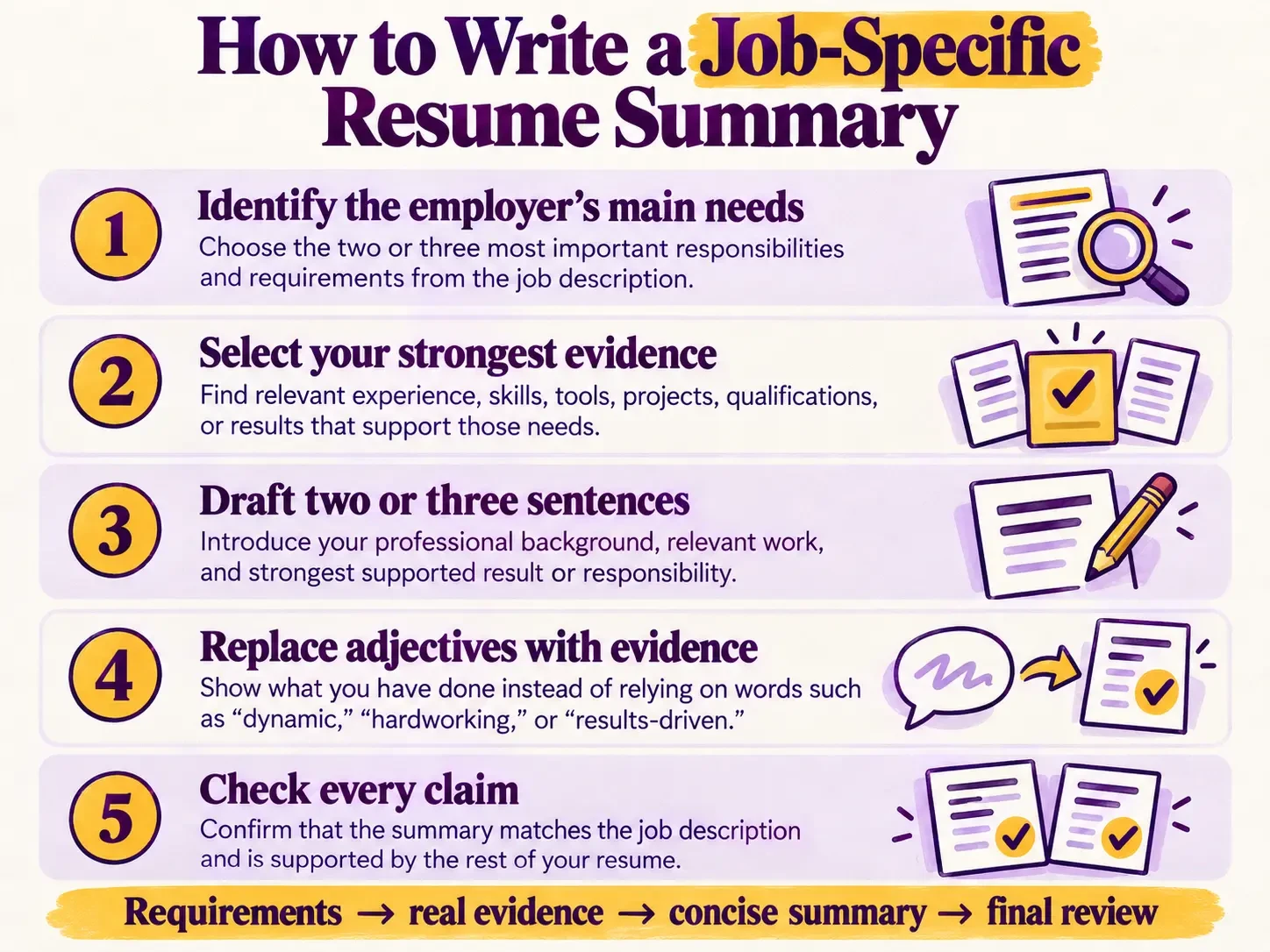
Start with the employer's two or three main needs
Read the responsibilities and requirements in the posting. Identify the work the person will actually perform and the skills needed to do it. For an email role, those might be campaign management, segmentation, and reporting.
Avoid trying to fit every keyword into the summary. Some requirements are better demonstrated in your experience, skills, or education sections. Our guide to finding keywords in a job description shows how to identify requirements and connect them to your experience.
Select your strongest supporting facts
For each main need, find something you have done that demonstrates it. Look for a relevant responsibility, tool, project, qualification, or result.
If the posting asks for something you have not done, leave that claim out. You can explain related experience accurately, as the retail-to-operations example does, without treating it as identical experience.
Draft two or three sentences
Use this flexible structure:
Accurate professional description with relevant experience or context. Work you have done using relevant skills or tools. A supported result, project, or responsibility that matters for this job.
You do not need all three sentences. A graduate can start with their degree and project experience. An experienced specialist can lead with their field and most relevant work. A career changer can keep their current professional identity and show the transferable responsibilities.
Use a number when it adds useful evidence. Years, team size, output, or a measured result can clarify your experience, but none is mandatory.
Replace adjectives with evidence
“Results-driven,” “dynamic,” and “hardworking” use space without explaining what you can do. Replace them with responsibilities or outcomes that support the quality you want to communicate.
For example, “strong organisational skills” becomes more useful when the reader learns that you coordinate contractor appointments and check invoices against work orders. The evidence gives them something concrete to assess.
Check the summary against both documents
Read the posting again, then your CV. Ask:
- Does the summary emphasise the work this employer needs?
- Can I support every claim with my actual experience?
- Are years in a specialist or management role distinguished from total years worked?
- Does my experience section substantiate the summary?
- Is there anything I can remove without losing useful information?
A summary creates an expectation that the rest of your CV needs to support. Continue the same emphasis through your relevant bullets and skills so the employer can follow the evidence. For the wider process, follow our guide to tailoring your full CV to a job, or see targeted CV examples covering summaries and experience.
Frequently asked questions
What is the difference between a CV summary and an objective?
A summary emphasises the experience and skills you bring. An objective emphasises the role or direction you want to pursue. We recommend leading with what you can contribute, including when you are changing careers. A short statement of direction can help explain a transition, but it should be attached to evidence of relevant work.
What should I write if I have no work experience?
Use relevant coursework, projects, volunteering, or other responsibilities you can describe honestly. Name the context so a class project is clearly a class project. The graduate example above shows how to do this without implying paid experience. If you have little relevant material, a shorter introduction is better than filling space with unsupported claims.
Is a professional profile necessary on every CV?
We recommend one when it helps the employer quickly connect your background to the role. It is especially useful when that connection is easy to miss, such as a career change or a broad career with several specialisms. If it only repeats a title and adds generic adjectives, improve it or use that space for stronger evidence. Follow any specific application instructions.
How long should a CV summary be?
Start with two or three sentences, usually about 40–70 words. Keep it short enough to scan comfortably. Avoid shrinking the font to accommodate another sentence; choose the most relevant details instead.
How do I make a CV summary ATS-friendly?
Use a clear heading and the posting's relevant terminology where your experience supports it. Name specific tools or qualifications accurately and support the summary in the rest of your CV. There is no universal summary score or keyword count that guarantees passing an employer's screening process.
Can I generate a CV summary for free?
Yes. Reztune's free tier includes three tailoring credits per month. Each credit generates a full CV tailored to one job description, including its summary. You can view the result for free; downloading the formatted PDF requires payment.
Can I use the same summary for every job?
We recommend reviewing and tailoring it for every application. Some wording may remain useful across similar postings, but the employer's priorities should determine what stays. The two marketing summaries above show how the same background can support different openings.
Make your experience easy to recognise
Your summary is a small part of the document, but it can give the employer a useful starting point: the work you know, the evidence you bring, and why it matters here.
Use the examples to write yours, or tailor your CV with Reztune to prepare the summary and full document around your next posting. You can generate and view the result using one of your three free monthly tailoring credits, then review how clearly it presents your fit before applying.